maandag 27 augustus 2012

Exceptional 46/5 miniatures Part 1 (of three).

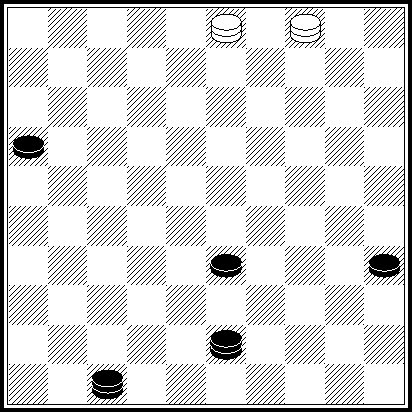
This article is the first of three, each of them with only one 46/5 miniature. All three have exceptional solutions, a lot of suprises, actions and counter actions, as well as a climax at the end. The main phases of the first of the three miniatures are first shown in this article by four diagrams, followed by Applets with the solution. The composition is the result of a rather peculiar cooperation between Andreas Kuyken and me. My part starts at the initial position and goes on till the second diagram. From there the solution continuous with a very interesting trip by the White King composed by Andreas, till the moment of the third diagram where two White Kings come into action. I found an original way of reaching the classic final by two unusual moves.

Dit artikel is het eerste van drie, elke daarvan met slechts één 46/5 miniatuur. Alle drie hebben buitengewone oplossingen, zijn vol met verrassingen, actie en tegenactie, hebben tevens een overtuigend slot. De belangrijkste momenten van de eerste van de drie miniaturen worden in dit artikel getoond met vier diagrammen, gevolgd door Applets met de oplossing. De compositie is het resultaat van een nogal ongebruikelijke wijze van samenwerking door Andreas Kuyken en mij. Mijn deel start met de aanvangsstand en gaat verder totdat het tweede diagram is bereikt. Daarna gaat de oplossing verder met een prachtige reis van de witte dam gecomponeerd door Andreas Kuyken, totdat vanaf het derde diagam twee witte dammen in actie komen. Dit toont een door mij meermalen bewerkt eindspel waar ik een originele manier, met twee ongebruikelijk zetten, gevonden heb om tot het klassieke slot te komen.

J.C.R. Bus

A. Kuyken

J.C.R. Bus

Classic

Obviously the solution must start with trying to go from the initial position to the second diagram. This seems to be very easy by playing the next moves: 38-32 (37 x 28) 45-40 (39-43) 44-39! (43 x 45) 12-8 (28 x 39) 8-2! and the winning position of the second diagram is reached. However, Black has another variant available. This one is shown by the first Applet. Special attention please for the forced moves (22-27!!), (32-37!) and (27-31!). At the end after (37-42) White cannot win by 36-27, because 44 is not on 39!

De oplossing moet natuurlijk beginnen met te proberen van de aanvangsstand te komen tot de winnende stand van het tweede diagram. Dat lijkt heel eenvoudig door de bovenstaande zetten te spelen. Echter zwart kan op 45-40 nog anders reageren. Zie de eerste Applet. Let speciaal op de gedwongen zetten (22-27!!), (32-37!) en (27-31!). Aan het eind na (37-42) kan wit niet winnen door 36-27, omdat 44 niet op 39 staat!

[White ""][Black ""][Setup "1"][FEN "W:W12,16,33,38,44,45,50:B1,19,22,23,37,39."] 1. 38-32 37x28 2. 45-40 28-32 3. 12-8 39x28 4. 8-3 22-27 5. 16-11 32-37 6. 40-34 27-31 7. 34-29 23x34 8. 11-7 1x12 9. 3x36 37-42


White can also play differently after 45-40 (28-32), but there is no way to win. The next Applet shows the right moves of the first part of the solution. White reaches almost the same position as of diagram 2 by playing the very unusual moves 8-3! and back again with 3 to 8!!. The moves are not interchangeable, after (43 x 34) White should not play 45-40 because (28x39) 34 x 21 is a draw.
Wit kan ook anders spelen na 45-40 (28-32), maar zwart kan zich altijd redden. De volgende Applet laat de juiste zetten zien van het eerste deel van de oplossing. Wit bereikt vrijwel dezelfde positie van diagram 2 door de zeer ongebruikelijke zetten 8-3! en weer terug van 3 naar 8!! De zetten zijn niet verwisselbaar, na (43 x34) kan wit niet winnen door 45-40 (28 x 39) 34 x 21 =.

[White ""][Black ""][Setup "1"][FEN "W:W12,16,33,38,44,45,50:B1,19,22,23,37,39."] 1. 38-32 37x28 2. 12-8 39-43 3. 44-39 43x34 4. 8-3 28x39 5. 45-40 34x45 6. 3-8


White has reached the winning position similar as the second diagram above (A. Kuyken). The big surprise now is that after (19-24!) White has to take 8 x 48!! instead of 8 x 43. The explanation is that after 8 x 43? the opposition is against White. For instance (23-29) 43-38 (29-34) 38-43 (34-40) 43-49 (22-28) 49 x 35 (28-32) 35-24 (32-37) 24-47 (1-6 of 7)=. After 8 x 48!! the opposition is in favor of White after (23-29) or (23-28). So Black is forced to play (22-27) and the solution goes on as in the next and final Applet. This last one gives the full solution of the miniature, with the two composers relieving each other.

Wit heeft de winnende positie bereikt vrijwel zo als die van het tweede diagram (A.Kuyken). De grote verrassing is nu dat na (19-24!) wit naar 48 moet slaan en niet zoals voor de hand ligt naar 43. De verklaring daarvoor is dat na 8 x 43? het tempo tegen zit voor wit. Bijvoorbeeld (23-29) 43-38 (29-34) 38-43 (34-40) 43-49 (22-28) 49 x 35 (28-32) 35-24 (32-37) 24-47 (1-6 of 7)=. Na 8 x 48!! is de oppositie na (23-29) of (23-28) ten gunste van wit. Zwart is daarom gedwongen (22-27) te spelen en de oplossing gaat dan verder als in de volgende Applet. Deze geeft de volledige oplossing van deze miniatuur, waarbij de auteurs zich afwisselen.

[White ""][Black ""][Setup "1"][FEN "W:W12,16,33,38,44,45,50:B1,19,22,23,37,39."] 1. 38-32 37x28 2. 12-8 39-43 3. 44-39 43x34 4. 8-3 28x39 5. 45-40 34x45 6. 3-8 19-24 7. 8x48 22-27 8. 16-11 23-29 9. 48-26 27-32 10. 26-3 1-7 11. 11x2 32-37 12. 3-20 29-34 13. 2-19 34-39 14. 19x41 39-44 15. 50x39 45-50 16. 20-14


The next two articles will also contain one exceptional 46/5 miniature each. Both are at least as spectacular as the one of this article.

De volgende twee artikelen zijn ieder ook aan een buitengewone 46/5 miniatuur gewijd. Beide zijn minstens zo spectaculair als die van dit artikel.

dinsdag 7 augustus 2012

A Classic 46/5 Idea

Gerrit de Bruijn informed me that informed me that the beautiful 46/5 idea, the final of the end games shown in this article, was published as early as 1787 in the second book of Manoury. According to Dufour the author of this position is Chalon. It contains two fully thematical variants and a third one with a thematical final. By the way, I have my doubts that anybody at that period of history found the number of thematical variants so important as many endgame composers do today.

Gerrit de Bruijn wist mij te melden dat het  het mooie 46/5 idee, dat bij de eindspelen in dit artikel het slot is, al gepubliceerd werd in het tweede boek van Manoury in 1787. Volgens Dufour is de auteur van deze stand Chalon. Deze stand bevat twee volkomen scherpe varianten en een derde variant met een scherpe slotstand. Ik heb mijn twijfels overigens of er in die periode van de geschiedenis iemand was die het aantal thematische varianten zo belangrijk vond als vele hedendaagse eindspel componisten.


(5-10) 35, 5     (46-41) 35, 46            (46-10) 33, 4                                                           

The first end game shown below was composed by the well known end game composer K.W.Kruijswijk . The nice initial positon has a straightforward solution leading to the position of Chalon.  Gerrit de Bruijn arranged (saved) the composition by moving the piece originally on 41 to 32.
Het eerste eindspel hieronder werd gecomponeerd door de bekende eindspel componist K.W. Kruijswijk. De  nette aanvangsstand heeft een rechtlijnige oplossing die naar het slot van Chalon voert. Gerrit de Bruijn heeft aangegeven waarom het stuk dat bij Kruijswijk op 41 stond naar 32 verhuizen moet.

43 (24-30) 39 (30-35) 11 (30, 40) 7 (45) 2 (50) 20! (46) 24! 

The next diagram shows a Black King that cannot move very much because it is blocked by its own Black pieces. Even when he gets more space later, the Black on 5 is still in the way of the Black King.

Het volgende diagram laat een zwarte dam zien die zich nauwelijks bewegen kan omdat hij geblokkeerd wordt door zijn eigen zwarte stukken . Zelfs als hij later meer ruimte krijgt, staat de zwarte op 5 hem nog in de weg. 


19 (4) 36 (40! 15) 34-30 (4-10) 25 (28) 41, 25-20

We continue with a variation of the final of Chalon. The endgame contains only a few pieces and a thematic variant with a very different final as 46/5. Added to that we see a surprising false solution, with which we start.

Wij gaan verder met een variatie op het slot van Chalon. Ondanks weinig stukkken bevat het eindspel een tweede scherpe variant met een heel ander slot dan 46/5. Bovendien nog een verrassende schijnoplossing waarmee wij beginnen.


- 1 (31) 11-7 (37) 2 (42!) 29 (20!!)=.

Two thematic variants. Twee scherpe varianten.


- 7 (31) 2 (37) 24 (14) 1 (19) 8! (20, 41) 1-29+
- 7 (31) 2 (37) 24 (41) 1 (46) 35! (46-14) 41, 20, 5+


For more 3 x 3 end games I can strongly recommend the book Kleingoed. It contains 700
3 x 3 end games and a lot more information about end games, useful both for players and for draughts-composers. Not only for end game composers, because the book contains very many “motives”, in a systematic way.

The text of the book is only in Dutch, but the systematic content is easy to follow for everybody.

The authors are Gerhard Bakker and Gerrit L. de Bruijn, a guarantee for correct variants.

For details about ordering the book I give you the email adres: gerhardb@telfort.nl


Of the 700 3 x 3 end games only 12 have 46/5 finals. Here is the list of the relevant numbers of Kleingoed. 

Kleingoed 46/5: 205, 207, 276, 291, 295, 299, 469, 475, 508, 574, 615 and 468 a variation of my end game shown above. 

Voor meer 3 x 3 eindspelen kan ik van harte het boek Kleingoed aanbevelen. Het bevat 700  3x3 eindspelen en veel meer infomatie over eindspelen, nuttig zowel voor spelers als voor problemisten . Niet alleen voor eindspel componisten want het boek bevat veel motieven, systematisch gerangschikt.

De auteurs zijn Gerhard Bakkker en Gerrit de Bruijn, dus een waarborg voor correcte varianten .

Om precies te weten te krijgen hoe men het boek bestellen kan, geef ik het email adres : gerhardb@telfort.nl


Van de 700 eindspelen hebben slechts 12 een 46/5 slot.   Zie boven voor hoe de 46/5 eindspelen in het boek te vinden zijn.

Many more 46/5 end games can be found in the also recommended book Dama Negra from Gerhard Bakker. See Chapter 4.8.2, page 157 and Chapter 4.8.6, page 167 as well as the registers for the relevant miniatures. For ordering see above.


Veel meer 46/5 eindspelen zijn te vinden in het eveneens aan te bevelen boek Dama Negra van Gerhard Bakker. Zie Hoofdstuk 4.8.2. bldz. 157 en Hoofdstuk 4.8.6, bldz 167. De relevante miniaturen zijn te vinden via de registers. Om het te bestellen zie boven.

donderdag 14 juni 2012

46/5 End Games

This article is the first part of a demonstration of end games resulting in one of the most beautiful final positions of draughts called 46/5. A large collection of thousands of compositions was collected by J.A. Pennings, who contributed a number of very nice 46/5 (and 5/46) compositions himself.
By far most of the collection are direct combinations resulting in 46/5, but there are quite a number of end-games too.
Below we start with an end game based upon an idea of Pennings as old as 1942. A few years later a cooperation between Scheijen and Duursma brought an extension of the idea. This end game is shown by the first Applet, with the moves 34-29, 29-24 as the highlight.

Dit artikel is het eerste deel van een demonstratie van eindspelen die eindigen met een van de mooiste slotstanden van het damspel, 46/5. Een grote verzameling van duizenden composities is samengesteld door J.A.Pennings, die zelf een aantal heel mooie 46/5 (en 5/46) problemen componeerde.
Verreweg de meeste van de collectie zijn directe combinaties die in 46/5 eindigen, maar er zijn ook nogal wat eindspelen.
Hieronder beginnen wij met een eindspel gebaseerd op een idee van Pennings dat hij reeds in 1942 publiceerde. Een paar jaar later bracht een samenwerking van Scheijen en Duursma een uitbreiding van het idee. De eerste Applet laat dit eindspel zien, het hoogtepunt daarbij zijn de zetten 34-29 en 29-24.


[White ""][Black ""][Setup "1"][FEN "W:W14,34,46:B22,25,31."] 1. 14-9 22-27 2. 9-3 31-37 3. 3-26 27-31 4. 34-29 25-30 5. 29-24 30x19 6. 46-41 37x46 7. 26x5


The next composition shows another interpretation of the idea, a bit more subtle with the move 3-12! the only one winning because it prevents (13-18). De volgende compositie laat een andere interpretatie van het idee zien, nog iets subtieler. De zet 3-12! is de enige die wint omdat (13-18)
 verhinderd moet worden.

.
[White ""][Black ""][Setup "1"][FEN "W:W21,25,26,28,30,32,33,37,47:B8,12,13,16,17,18,19,22."] 1. 37-31 16x29 2. 26-21 17x37 3. 28x17 12x21 4. 30-24 19x30 5. 25x3 21-27 6. 3-12 13-19 7. 12-26 27-31 8. 47-41 37x46 9. 26x5


  The application of the idea is matured in the next composition that I published 60 years later than 1942! The most peculiar thing of this composition is that in the initial position all the fields of the line 46 to 5 are occupied!!. The end game contains another thematic variant found by Romanov: After 3 (22) 21 (36) 32 (10, 27) 37 (41) 31, 37. De toepassing van het idee is volwassen geworden met de volgende compositie die ik publiceerde 60 jaar later dan 1942! Het meest opmerkelijke van deze compositie is dat in de aanvangsstand alle velden van de lijn 46 tot en met 5 bezet zijn . Het eindspel bevat nog een tweede thematische variant, gevonden door Romanov. Zie boven.


[White ""][Black ""][Setup "1"][FEN "W:W14,19,20,24,25,30,34,35,39,41,46,49:B3,5,10,17,18,22,23,28,32,37,38."] 1. 19-13 10x8 2. 24-19 23x14 3. 20x9 3x14 4. 25-20 14x25 5. 39-33 38x40 6. 35x44 25x34 7. 44-39 34x43 8. 49x27 22x31 9. 41x3 17-22 10. 3-21 22-28 11. 21-17 28-32 12. 17-21 32-37 13. 21-26 5-10 14. 46-41 37x46 15. 26x5


Not only that all the fields of the line 46 to 5 were occupied, finally the two remaining are White at 46 and Black at 5, before they are converted to a Black King on 46 and a White King on 5! Niet alleen dat alle velden van de lange lijn bezet waren, aan het eind blijven alleen een witte op 46 en een zwarte op 5, voordat ze worden omgetoverd tot een zwarte dam op 46 en een witte dam op 5! The next 46/5 end game is totally different. The most interesting moment is after (24-29) 12-7 where (29-33) 44-39 is an easy win for White. However, Black plays (13-19!) with the surprising effect that only 46- 41! wins. Het volgende 46/5 eindspelletje verloopt totaal anders. Het meest interessante moment komt na (24-29) 12-7 waar (29-33) 44-39 gemakkelijk wint voor wit. Echter, zwart speelt (13-19!) met als verrassend effect dat alleen 46- 41! wint.


[White ""][Black ""][Setup "1"][FEN "W:W31,34,38,39,40,42,43,44,46:B2,13,18,21,22,23,24,29,35."] 1. 31-27 21x32 2. 38x27 22x31 3. 42-37 31x42 4. 43-38 42x33 5. 39x8 2x13 6. 34x12 24-29 7. 12-7 13-19 8. 46-41 29-33 9. 44-39 33x44 10. 40x49 35-40 11. 7-1 40-45 12. 49-44 45-50 13. 1-23 50x46 14. 23x5


 L. Schut was one of the best known Dutch end game composers in the middle of the 20th century. He was inspired by the beautiful 46/5 idea of A. Sjosjin.

L. Schut was een van de meest bekende eindspel componisten tijdens het midden van de 20ste eeuw. Hij bewerkte het 46/5 idee van A.Sjosjin, waarover hij terecht lovend sprak.


.
[White ""][Black ""][Setup "1"][FEN "W:W12,22,K50:B10,23,26,29."] 1. 12-8 26-31 2. 8-3 31-36 3. 22-18 23x12 4. 3x21 36-41 5. 21-49


  Based upon a brilliant and funny final by C.Kusters I present here a rather peculiar end game where Black tries to escape with sacrificing most of his pieces. Kusters version of the final was with the White King on 35, but that is very difficult to extent to an end game.
Try to find the solution yourself!

Gebaseerd op een prachtig gevonden en grappige finale van C. Kusters laat ik hier een eindspelletje zien waarin Zwart probeert te ontsnappen door de meeste van zijn stukken te offeren. In de versie van Kusters staat de witte dam op 35, maar dan is het heel moeilijk er een uitbreiding aan te geven.
Probeer zelf de oplossing te vinden!


In a next article  I will present some more and very different ways of reaching 46/5, some of them very spectacular.

In een volgend artikel laat ik nog een aantal en sterk verschillende manieren zien om 46/5 te bereiken. Enkele daarvan zijn heel spectaculair.


donderdag 19 april 2012

End Games Dutch Championship 2012 Part 2

As said before, making comments is much easier than playing. The idea of my articles is to show the beauty of the game in such a way that we all, including the writer, can learn about draughts. In particular about calculating the moves in the end phase of the game.

Zoals eerder gezegd, commentaar geven is veel eenvoudiger als een goede partij spelen. Het idee van mijn artikelen is de schoonheid van ons spel te laten zien op een zodanige manier dat wij allen, inclusief de schrijver, er wat van kunnen leren. In het bijzonder wat betreft het berekenen van de zetten in de eind-phase van een partij.


Pim Meurs

The diagram below gives the impression that it is Black that had the initiative during the game concerned. This was actually the case and that might have caused that Ron Heusdens (White) was under pressure against Pim Meurs (Black). Maybe that influenced Ron so that he did not trust playing 40-35 because of (25-30, 23-29) after which 26-21 is forced and 21 will be captured at the next move by the Black King. That is a possible explanation for that Ron played 43-38, calculating that a few moves later he could force a 6 x 6 end game with two potential promotions at each side.

Het diagram hieronder wekt de indruk dat zwart het initiatief had in de betrokken partij. Dat was ook inderdaad zo en mogelijk heeft Ron Heusdens (wit) zich onder druk gevoeld tegen Pim Meurs (zwart). Wellicht heeft dat invloed gehad op Ron en vertrouwde hij 40-35 niet, omdat na (25-30, 23-29) 26-21 gedwongen is en het stuk op 21 bij de volgende zet door de zwarte dam geslagen wordt. Dat is een mogelijke verklaring voor dat Ron 43-38 speelde, met zicht op een wederzijdse doorbraak naar een 6 x 6 eindspel waarbij beide partijen wellicht met twee stukken op dam zouden kunnen komen.


However, these considerations of Ron Heusdens were far from precise. First about 40-35.
From the first diagram to the second one the moves are:

40-35 (25-30, 23-29) 26-21 (29 x 49) 21 x 21 (49 x 16) 39-34.

De overwegingen van Ron Heusdens waren echter verre van nauwkeurig. Eerst wat 40-35 betreft. Van het eerste diagram naar het tweede als boven aangegeven.


Obviously a draw. See (24-29, 22-28, 16 x 47)=. Otherwise the Black King will be captured, also after (22-27).

Duidelijk remise. Zie (24-29, 22-28. 16 x 47)=. Anders wordt de zwarte dam gevangen, ook na (22-27).

This means that Ron could have forced the draw by playing from the first diagram:
40-35! (11-16) 37-31! (25-30, 23-29) 39-34!! w+
40-35 (11-16) 37-31! (25-30, 27-32) 25-20, 42-38=.
40-35 (11-16) 37-31! (16-21) 34-30!=.

Dat betekent dat Ron de remise had kunnen forceren vanuit het eerste diagram, zoals hierboven aangegeven.

This would have been a disappointment for Pim Meurs after such a good game. However, Ron did nor play 40-35, but 43-38? and then Pim could prove again what a strong player he is. The victory is forced systematically. See the first Applet that includes the final combination, though Ron righly surrendered after (30-34) 17-11.

Dit zou een teleurstelling voor Pim geweest zijn na zo een goede partij. Echter, Ron speelde geen 40-35, maar 43-38? waardoor Pim weer eens bewijzen kon dat hij een sterke speler is. De overwinning wordt systematisch afgedwongen. Zie de eerste Applet die ook de laatste combinatie laat zien, hoewel Ron het terecht na (30-34) 17-11 al opgaf.

[White ""][Black ""][Setup "1"][FEN "W:W26,33,34,36,37,39,40,42,43:B11,17,18,22,23,24,25,27,28."] 1. 43-38 11-16 2. 40-35 16-21 3. 37-31 28-32 4. 33-28 22x44 5. 31x11 32x43 6. 26x17 43-48 7. 42-38 48x30 8. 11-6 44-49 9. 38-33 30-34 10. 17-11 24-30 11. 35x24 34-39 12. 33x44 49x16


The next game (between Jeroen v.d. Akker and Pim Meurs) was really exciting. The Applet shows how Pim, after 32-27 of Jeroen, managed to weaken the left side of White. However, at the end of the Applet Jeroen played 45-40! with the efect that the right side of Black was weakened as well! The result was a position that contained a lot of surprises. Even a surprise the players were not aware of!

De volgende partij (tussen Jeroen v.d. Akker en Pim Meurs) was echt vol verrasingen. De Applet laat zien hoe Pim, na 32-27 van Jeroen, kans zag de de linker vleugel van wit uit te dunnen. Echter, aan het eind van de Applet speelde Jeroen 45-40! waarna Pim, om nog winstkansen te hebben, zijn rechter vleugel moest verzwakken! Daaruit resulteerde een positie vol met verrassingen. Zelfs een verrassing waarvan de spelers zich waarschijnlijk niet bewust waren!

[White ""][Black ""][Setup "1"][FEN "W:W22,31,32,35,38,40,42,43,45:B2,4,8,11,12,13,15,20,24."] 1. 32-27 12-17 2. 22-18 13x22 3. 27x18 2-7 4. 40-34 20-25 5. 42-37 4-9 6. 37-32 11-16 7. 38-33 16-21 8. 31-27 8-13 9. 27x16 13x22 10. 45-40


See the diagram below. The variants show that Black is forced to play (7-12) in order to keep a chance to win. White could have answered with 34-29 or even 33-28, 32-27 that gives a difficult draw. However, White played 43-39!! which was a stroke of genious, but at the next move Jeroen proved that he was not aware of that!!


- (9-14) 33-28!, 34-29=.
- (9-13) 43-39 followed by 32-28 =.

Zie bovenstaand diagram. De varianten laten zien dat zwart (7-12) moet spelen om nog een kans op winst te hebben. Wit zou hebben kunnen antwoorden met 34-29 of zelfs 33-28, 32-27 met een benauwde remise. Echter Jeroen speelde de geniale zet 43-39!! Bij de volgende zet bleek echter dat hij zich dat niet bewust was!!

So from the preceding diagram the game went on with:
(7-12) 43-39 (9-14)
Dus vanaf het vorige diagram ging het spel verder met zie boven.


Now we are at the most interesting position of the game. I suppose that Pim started believing that he would win and that Jeroen realized that he was in a very difficult position, because he now calculated that after 34-29 (14-19, 15 x 24) he had to surrender. 32-28 is not possible then and after 40-34 (19-23) he does not have any further chance.

Nu zijn we bij de meest opmerkelijke positie van de partij. Ik neem aan dat Pim op dit moment begon te denken dat hij zou winnen en dat Jeroen berekende dat hij na 34-29 (14-19, 15 x 24) verliest. 32-28 gaat dan niet en na 40-34 (19-23) zou hij kansloos zijn.

However, draughts surprises us every day. This time with an amazing escape!

34-29! (14-19, 15 x 24) 16-11!! 32-28 (12-17) 40-34! // 39-34?? (27) or the crazy win (17-21!!)// (6-11) 34-29 (11-16) 29 x 20 (25 x 14) 39-34! (16-21) 34-29 (21-26) 35-30! (27-31) 29-24=.

Because Jeroen did not see how brilliant his 43-39! was, he played 32-28. The game went on with (22-27) 34-29. See the next diagram.

Omdat Jeroen niet zag waarom zijn zet 43-39! zo geweldig was, speelde hij 32-28. Het spel ging verder met (22-27) 34-29. Zie het volgende diagram.


Pim now played (15-20) because he considered it the best way of preventing 28-23.
- (15-20) 28-23 (27-32) 39-34 (14-19) z+.

Pim speelde nu (15-20) omdat hij dit de beste manier vond om 28-23 tegen te gaan. Zie boven.

However, below is the prove why it was wrong. What matters is that (14-20!) is also winning after 28-23 and much better against the variant 40-34, 35-30, 28-22 as played by Jeroen in the game. Draughts is not easy!

- (14-20!) 28-23 (27-32) 39-34 (32-37) 23-28 (37-41) 18-13 (41-46!) z+.

- (14-20!) 40-34 (27-31) 35-30, 28-22, 33 x 22 (31-37) 16-11 (12-17) z+.

Het blijkt dat Pim de winst verspeelde door (15-20?). Met (14-20!) had hij die alsnog voor het grijpen. Zie de twee bovenstaande varianten. Dammen is geen eenvoudig spel!

The game went on as by the Applet. At the end it is not difficult anymore to see why 14 should be better on 15!

Het spel ging verder zoals de Applet laat zien. aan het eind is het niet moeilijk meer om te zien dat 14 beter op 15 had gestaan!


[White ""][Black ""][Setup "1"][FEN "W:W16,32,33,34,35,39,40:B12,14,15,17,22,24,25."] 1. 32-28 22-27 2. 34-29 15-20 3. 40-34 27-31 4. 35-30 24x35 5. 28-22 17x28 6. 33x22 31-37 7. 16-11 12-17 8. 11-7 17x28 9. 7-2


When Pim would have played (14-20) he likely had won as in the next Applet.

Als Pim (14-20) had gespeeld had hij waarschijnlijk gewonnen als in de volgende Applet.


[White ""][Black ""][Setup "1"][FEN "W:W16,32,33,34,35,39,40:B12,14,15,17,22,24,25."] 1. 32-28 22-27 2. 34-29 14-20 3. 40-34 27-31 4. 35-30 24x35 5. 28-22 17x28 6. 33x22 31-37 7. 22-18 12x23 8. 29x18 37-42 9. 18-13 42-48 10. 13-9 20-24


Pim did not always had such a difficult game. To illustrate that we have a look at the game against Michel Kroesbergen. Michel had a very successful tournament, the only loss was against Pim. However in this game it went very fast very wrong for Michel.

Pim had niet altijd een zo moeilijke partij. Om dit te illustreren kijken we naar de partij tegen Michel Kroesbergen die een goed toernooi speelde. De enige nederlaag van Michel was tegen Pim. Maar dat ging dan ook erg vlot.


Pim forced the win as follows by playing 37-31!. Michel had nothing better than (25-30), with the following variants in mind. The first one is really smart, but the second one proved to be a disaster for Michel. See the Applet.

- 37-31 (25-30) 24 x 35 (2-7!!)=.
- 37-31 (25-30) 34 x 25 (13-19, 8 x 28).

Pim forceerde hier de winst door 37-31! te spelen. Michel heeft niets beters dan (25-30) waarbij hij de bovenstaande varianten in gedachten had. De eerste is slim, maar de tweede bleek een ramp voor Michel. Zie de Applet.


[White ""][Black ""][Setup "1"][FEN "W:W23,24,26,29,33,34,36,37,38,39,40,42,43,44,45,47:B2,3,6,8,10,11,12,13,14,15,17,18,20,22,25,27."] 1. 37-31 25-30 2. 34x25 13-19 3. 24x13 8x28 4. 40-34 3-9 5. 38-32 27x40 6. 31-27 22x31 7. 33x4


Pim Meurs is also interested in draughts compositions and tries to improve his capabilities in that respect. I appreciate that of course and I wish him a lot of success in both ways to enjoy draughts.

Pim Meurs heeft ook belangstelling voor dam-composities en is doende zijn vaardigheden ook in dit opzicht te verbeteren. Ik waardeer dat natuurlijk en wens hem veel succes bij beide manieren plezier aan dammen te beleven.

maandag 16 april 2012

End Games Dutch Championship 2012

Feike Boomstra won a few years ago an International Championship Computer Draughts, shortly before he went seriously ill and died. Now his son, Roel Boomstra is the new Dutch Champion Draughts! We very much regret that his father could not be present at this fantastic success.
The first fragment of this article shows one of the victories of Roel in the Dutch Championship 2012. He calculated from the initial position of the Applet all the winning moves that followed, including the conclusion that the end game will win. The Applet starts after his opponent Ron Heusdens had played 36-31, based upon the idea that after (20-25) the moves 31-26 and 27-21 will give a draw.

Feike Boomstra won een paar jaar geleden een Internationaal Kampioenschap Computerdammen, kort voordat hij ernstig ziek werd en overleed. Nu is zijn zoon, Roel Boomstra de nieuwe Kampioen van Nederland Dammen! Het is zeer te betreuren dat zijn vader niet aanwezig kon zijn bij dit enorme succes.
Het eerste fragment van dit artikel laat een van de overwinningen zien van
Roel in het NK 2012. Hij berekende vanaf de start-positie van de eerste Applet alle winnende zetten die volgden, tot hij de conclusie bereikte dat het eindspel winnend is. De Applet begint nadat zijn tegenstander Ron Heusdens 36-31 had gespeeld in de overtuiging dat na (20-25) de zetten 31-26 en 27-21 de remise zouden brengen.

[White ""][Black ""][Setup "1"][FEN "B:W22,27,30,31,35,43,45:B3,9,11,12,19,20,24."] 1... 20-25 2. 31-26 25x34 3. 27-21 11-16 4. 21-17 12x21 5. 26x17 3-8 6. 22-18 16-21 7. 17x26 24-29 8. 26-21 19-23 9. 21-16 23x12 10. 16-11 12-17 11. 11x22 8-12 12. 43-38 34-39 13. 45-40 29-34 14. 40x29 39-44 15. 29-24 44-50


A perfect victory. After (19-23) White could have reached the promotion line, but would have lost anyway.
(19-23) 18-13 (9 x 18) 21-17 (29-33) 17-11 (8-12) 11-6 (23-29) z+.

Een perfecte winst. Na (19-23) had wit nog op dam kunnen komen, maar, zoals hierboven aangegeven, zonder enige remisekans.

Alexander Baljakin

Alexander Baljakin again proved what a great player he is. However, he was not lucky during this tournament. The first round resulted in a nightmare for him and in the game against Steven Wijker he missed two opportunities to win the end game. See the diagram below for the first chance given to Alexander by Steven.

Alexander Baljakin liet weer zien dat hij een uitzondelijk sterke speler is. Echter, hij had geen geluk tijdens dit toernooi. Het begon met een nachtmerrie en in de partij tegen Steven Wijker miste hij tweemaal de winst in het eindspel. Zie het diagram hieronder voor de eerste kans die Steven aan Alexander gaf.


For unclear reasons Steven Wijker played 10-41? After 34-29 or 10-23 there is not so much to fear.
The game went on as follows to the second diagram. Of course it is much easier to comment than to play.

(49-40) 34-30, 24-20 (40-35) 41-14.

Steven Wijker kwam hierboven op het onzalige idee 10-41 te spelen. Na 34-29 of 10-23 zou er niet veel aan de hand geweeest zijn. Het spel ging verder als aangegeven naar het tweede diagram. Het is natuurlijk veel eenvoudiger commentaar te geven als te spelen.


Both players do not understand the end game. There is no need for a computer to see that the moves given below are winning for Black and that when White plays 20-15 instead of 20-14, Black plays (34-39) and will get as many Kings as he likes.

(3-9!) 14 x 3 (35-19) 20-14 (19 x 5) 3-25 (5-28, 26 x 37) 36-31, 45-40 (26-31) z+.

Beide spelers begrijpen niet welke mogelijkheid zich voordoet in dit eindspel. Er is geen computer nodig om te zien dat de bovenstaande zetten winnen voor zwart en dat als wit 20-15 speelt i.p.v. 20-14, zwart met (34-39) zoveel dammen haalt als hij wil.

The next Applet shows how the game went on starting from the first diagram above till the second mistake by Steven giving Alexander another opportunity to win.

De volgende Applet geeft de zetten vanaf het eerste diagram hierboven tot het moment waar Steven de tweede fout maakt die Alexander een nieuwe mogelijkheid gaf te winnen.

[White ""][Black ""][Setup "1"][FEN "W:WK10,24,34,36,45:B3,21,25,26,27,K49."] 1. 10-41 49-40 2. 34-30 25x34 3. 24-20 40-35 4. 41-14 35-13 5. 20-15 13-4 6. 14-25 4-9 7. 25x43 9-14 8. 43-48 14-5 9. 45-40 3-9 10. 40-35 9-13 11. 35-30 13-18


According to Internet Steven played 30-25?? and Alexander (18-22??). The variants below prove that Black could have surpassed the line 47....20 and win. With 30-24 White could have prevented that and still keep the draw. Also here no computer is required to see that.
This case together with the incident of the first round costed Alexander Baljakin two points, just what he was missing at the end for getting equal with Roel Boomstra. However, as shown below Roel also missed two winning moves in the same game! So everybody will be satisfied with the final result!
- 30-25 (18-23) 48-42 (5-10) 15 x 4 (23-28, 26 x 48) 36-31, 25-20 (26-31) z+
- 30-25 (18-23) 25-20 (23-29) z+.
- 30-24 (18-23) 24-19, 15-10 =.

Volgens Internet speelde Steven 30-25?? en Alexander (18-22??). Bovenstaande varianten laten zien dat zwart de lijn 47......20 had kunnen overschrijden en zo winnen. Met 30-24 had wit dat kunnen voorkomen en zo de remise houden. Ook hier heeft men geen computer nodig om dat te zien.
Samen met het incident in de eerste ronde kwam Alexander Baljakin twee punten tekort om met Roel Boomstra gelijk te eindigen. Echter, ook Roel miste in een partij twee keer de winst! Aldus is toch iedereen tevreden met de einduitslag!

Roel Boomstra

The first two Applets shows that Jasper Lemmen played the weak move 43-38? and how Roel could have reached a winning end game.
However, Roel missed the opportunity by playing (11-16?). The third Applet gives the way Jasper Lemmen should have played to reach the draw.

De eerste twee Applets laten zien dat Jasper Lemmen de zwakke zet 43-38? speelde en hoe Roel het daarna had kunnen winnen.
Roel miste die kans echter door (11-16?) te spelen. De derde Applet laat zien hoe Jasper daarop remise had kunnen maken.

[White ""][Black ""][Setup "1"][FEN "W:W28,30,31,32,35,43:B11,17,18,19,23,24."] 1. 43-38 18-22 2. 38-33 23-29 3. 32-27 29x38 4. 27x18 38-42 5. 28-23 19x28 6. 30x19 42-47 7. 18-13 47-36


The second variant, about which Roel Boomstra himself wrote me,requires very precise moves by Black of which this time (11-16!) is the decisive one.

De tweede variant, waarover Roel Boomstra zelf mij schreef, vereist heel precies spel van zwart, waarbij nu wel (11-16!) de beslissing brengt.

[White ""][Black ""][Setup "1"][FEN "W:W28,30,31,32,35,43:B11,12,17,18,19,23,24."] 1. 43-38 18-22 2. 38-33 23-29 3. 31-26 29x27 4. 28-23 19x28 5. 30x19 28-32 6. 19-14 32-37 7. 14-9 11-16


[White ""][Black ""][Setup "1"][FEN "W:W28,30,31,32,35,43:B11,17,18,19,23,24."] 1. 43-38 18-22 2. 38-33 11-16 3. 30-25 23-29 4. 32-27 29x38 5. 27x18 38-42 6. 28-23 19x28 7. 18-13 42-48 8. 13-9 48x26 9. 9-4 17-21 10. 35-30 24x35 11. 25-20


After Lemmen missing the draw, Boomstra played all the right moves as in the next Applet, till the unfortunate moment came that he played (33-38?), causing troubles for his own King. One additional remark: Black could have made it easier a few moves before by playing (43-21) instead of (28-32).

Nadat Lemmen de remise gemist had speelde Boomstra al de goede zetten zoals de volgende Applet laat zien, totdat het ongelukkige moment kwam dat hij
(33-38?) speelde en zodoende zijn eigen dam op 43 hinderde. Overigens, zwart had het zich al eerder gemakkelijker kunnen maken door (43-21) te spelen i.p.v. (28-32).

[White ""][Black ""][Setup "1"][FEN "W:W13,25,31,35:B16,17,24,28,K48."] 1. 31-27 28-33 2. 13-9 48-43 3. 27-22 17x28 4. 9-4 28-32 5. 35-30 24x35 6. 25-20 32-37 7. 20-14 37-41 8. 14-9 41-47 9. 9-3


It is much easier giving comments than playing. The player maybe tired or disappointed that it was so difficult to win his superior position.
Anyway, Roel should have played here (43-32) or (43-34), so that the Black King gives room to his pieces. It would have been interesting to see how the players would have handled the winning five Kings against two end game.
Roel played (33-38?) and Lemmen reacted very well with 3-25! resulting in the next variants.

- (33-38?) 3-25! (43-49) 4-36! (49-44) 25-48 (44-40) 48-26 =.
- (33-38?) 3-25! (43-48) 4-27! =.

Het is veel makkelijker commentaar te geven dan te spelen. De speler kan vermoeid zijn of teleurgesteld dat het zo moeilijk is zijn superieure positie te winnen.
Hoe dan ook, Roel had hier (43-32) of (43-34) moeten spelen om ruimte te geven voor zijn stukken om te promoveren. Het zou interessant zijn geweest om te zien hoe de spelers met het winnende eindspel van 5 dammen tegen twee zouden zijn omgegaan.
Roel speelde (33-38) en Lemmen reageerde alert met 3-25! waarna Boomstra vanwege bovenstaande varianten in remise moest berusten. In de volgende partijen bleef hij sterk spelen en werd de terechte kampioen!

When we study games of Roel Boomstra and Alexander Baljakin then Pim Meurs should be in the spotlights as well. He played a successful tournament and collected as many points as Baljakin. In my next article I will pay attention to his victories and a missed opportunity.

Als wij partijen bekijken van Roel Boomstra en Alexander Baljakin dan hoort Pim Meurs ook in de schijnwerpers te komen. Hij speelde een sterk toernooi en verzamelde net zoveel punten als Baljakin. In mijn volgende artikel zal ik aandacht besteden aan zijn overwinningen en een gemiste kans.

donderdag 5 april 2012

Babys and Twins

Below a collection of outstanding compositions that are easy to understand though containing big surprises. The five Dutchmen presented here were already active as composers more than 50 years ago, two of them are even about 90 years old now and still active.
They all tried finding new surprising finals and liked the challenge to present them in the best possible way. Not only attractive for problemists, but also for the much larger world of players.

Dit artikel laat een aantal zeer geslaagde composities zien die gemakkelijk te begrijpen zijn en toch unieke verrasingen brengen. De vijf Nederlanders in dit artikel waren al meer dan 50 jaar geleden actief als problemist, twee van hen zijn nu zelfs ongeveer 90 jaar oud en nog actief.
Ze hebben gemeen dat ze zochten naar nieuwe verrassende finales en gingen de uitdaging aan die zo goed mogelijk aan te kleden. Niet alleen attractief voor problemisten, maar ook voor de veel grotere wereld van de spelers.

First of all a little masterpiece of J.J. van Tol. I remember him driving me through a part of Rotterdam in his big American car, fully relaxed and happy. In this part of Rotterdam experienced women offered young students body to body lessons with quaranteed result, to a much reduced price. Of course only when the lady had a free hour available. When in the opinion of the lady the young man managed the lessons to mutual satisfaction, each third lesson was for free. A nice arrangement, the only thing was that I did not like her chocolate!
Jan and I said to each other that we wasted our time with draughts, but that we should not stop before making the ideal composition.

The one presented here comes close to that ideal, though about 1 second is enough for many draughts players to see the solution. However, the effect is marvelous.

Als eerste een meesterstukje van J.J. van Tol. Mijn sterkste herinnering aan hem was dat hij mij door een buurt Rotterdam reed in zijn grote Amerikaanse slee, volledig ontspannen en gelukkig. In deze buurt van Rotterdam boden ervaren vrouwen jonge studenten intieme lessen aan met gegarandeerd resultaat, tegen een sterk gereduceerde prijs. Echter alleen als de dame een uur vrij kon maken. Vond zij dat de jongeman de lessen tot wederzijdse bevrediging volbracht had dan was iedere derde les gratis. Netjes geregeld, het enige was dat ik haar chocolade niet lekker vond!
Jan en ik zeiden tegen elkaar dat wij onze tijd verspilden aan dammen, maar dat wij pas zouden stoppen als we het ideale probleem gemaakt hadden. Het stukje hier komt daarbij in de buurt hoewel een beetje redelijke dammmer niet meer dan ongeveer 1 seconde nodig heeft om de oplossing te vinden. Maar het effect met zo weinig stukken en zoveel meerslagen is zo fantastisch dat het stukje een blijvende indruk achterlaat.

[White ""][Black ""][Setup "1"][FEN "W:W31,33,35,39,41,43,50:B22,23,24,27,30,32,34."] 1. 43-38 27x47 2. 38x20 47x15 3. 35x24 15x44 4. 50x30


Maybe you found this one too easy, so the next one will take more than 1 second to solve. The author is nobody less than K.W. Kruijswijk a famous end game composer. He was born 21-7-1921 and still in very good condition. The quality of the composition from the initial position to the amazing position after (22 x 33) speaks for itself.

Wellicht zijn er die deze eerste te eenvoudig vinden, de volgende kost daarom meer dan 1 seconde om de oplossing te zien. De auteur is niemand minder dan K.W. Kruijswijk een beroemde eindspelcomponist. Hij is geboren op 21-7-1921 en nog steeds in een uitstekende conditie.
De kwaliteit van de compositie spreekt voor zich, vanaf de beginstand tot de unieke positie na de slag ( 22 x 33).

[White ""][Black ""][Setup "1"][FEN "W:W33,34,38,39,42,43,47:B10,14,18,19,22,24,28."] 1. 34-29 14-20 2. 29-23 18x29 3. 39-34 28x37 4. 34x5 37-42 5. 5-28 22x33 6. 38x29 24x33 7. 47x29


In my view the next one is even more impressive. The author is D. Vuurboom, many times Dutch Champion composition. He took the challenge of reaching the final position 45 / 50, not as usual with a King on 50, but a Man. Difficult to achieve, but he managed and in such a way, that all the other efforts of many other composers became obsolete. The piece on 45 comes from very far!

Naar mijn smaak is de volgende nog indrukwekkender. De auteur is D. Vuurboom die vele malen het KvD kampioenschap won. Hij nam de uitdaging aan de positie 45 /50 te bereiken, niet zoals ongeveer honderdduizend maal vertoond met een dam op 50, maar met een schijf. Moeilijk te bereiken, maar het lukte hem op een manier die alle andere maaksels van diverse problemisten overbodig maakte. Het stuk op 45 komt van heel ver!

[White ""][Black ""][Setup "1"][FEN "W:W33,38,39,41,42,43,44,48:B7,17,20,22,23,27,28,36."] 1. 38-32 36x40 2. 32x1 40-45 3. 1x15 28-32 4. 33-28 22x44 5. 15-38 32x43 6. 48x50


The next author D. de Ruiter is almost 90 , but stll searching for new surprising finals though he found countless before and presents them in the best possible way. He published a book with his compositions called "Schijven Spreken" which means something like that a good composition does not need comments, the story is told on the draughts board.
Nevertheless he has a comment on this one, he considers it his favorite composition! I more than agree with that, it is one of the best draughts compositions ever in my view.

De volgende auteur D. de Ruiter is bijna 90, maar nog steeds op zoek naar nieuwe en verrassende motieven, hoewel hij er al ontelbare gevonden heeft en vaak met succes bewerkt. Hij heeft een boek gepubliceerd "Schijven Spreken" wat men kan interpreteren als dat goede composities geen commentaar behoeven.
Toch heeft hij eens gezegd dat dit zijn favoriete produkt is. Dat kan ik mij goed voorstellen maar het is wat te bescheiden. Het behoort naar mijn smaak tot de absolute top van de dam-composities ooit gemaakt.

[White ""][Black ""][Setup "1"][FEN "W:W25,26,27,32,38,42,43,45,48:B17,18,23,29,30,34,35,40."] 1. 43-39 34x43 2. 25x34 43-49 3. 26-21 17x26 4. 27-21 26x17 5. 32-28 23x43 6. 34x21 40-44 7. 48x50 49x16 8. 42-38


An amazing composition and if it was not enough, even with two sharp ways to conclude!
Een verbazingwekkende compositie en alsof het nog niet genoeg was ook nog met twee scherpe mogelijkheden aan het eind!

Each of these babys of van Tol, Kruijswijk, Vuurboom and the Ruiter is not only nice and a beauty, but also of a very high standard. I need a pair of twins to reach a comparable level!
My twins are very look alike, the main variant is very much the same. However, each half of a pair of twins is an individual. A part, a variant, is totally different.
The next Applet shows the main variant of the first of the twins. It will be clear that, as first moves, 31-26 (21-27, 13-19) bring a very easy draw for Black. The main variants of both twins do not only have the climax 50-44 in common, but also the crazy moves 10-5, back from 5 to 10 and back again from 10 to 5!

Elke van deze babys van van Tol, Kruijswijk, Vuurboom en de Ruiter is niet alleen mooi, maar ook van hoge kwaliteit. Om een vergelijkbaar niveau te bereiken heb ik een tweeling nodig!
Het zijn één-eiige tweelingen, de hoofdvarianten zijn vrijwel gelijk. Echter, iedere helft van een tweeling is een zelfstandig individu. Een deel, een variant, is volkomen anders. De volgende Applet laat de hoofdvariant van de eerste van de tweeling zien. Het zal duidelijk zijn dat 31-26 (21-27, 13-19) als eerste zetten, voor zwart een gemakkelijke remise brengen. De hoofdvaranten van beide tweelingen hebben niet alleen de clomax 50-44 gemeen, maar ook de gekke zetten 10-5, terug van 5 naar 10 en weer terug van 10 naar 5!

[White ""][Black ""][Setup "1"][FEN "W:W23,25,29,30,31,32,38,50:B12,13,14,18,20,21,22,45."] 1. 32-28 22x35 2. 31-26 18x29 3. 26x10 29-34 4. 25x14 34-39 5. 10-5 35-40 6. 5-10 40-44 7. 10-5 44-49 8. 50-44 49x10 9. 5x28 39x50 10. 28-6


However, the composition has more to offer. A rather unusual variant, White has to be very precise. Below first the false solutions, then the right one.


-(24) 4! (34) 33? (34-40?) 28 w+
-(24) 4! (34) 33? (29!, 39) 27 (40)=.

-(24) 4! (34) 15! (30) 38-33! (34-40, 38, 40) 33 (44, 50) 6.

Uit diagram en notatie hierboven kan men zien dat de compositie meer te bieden heeft dan de hoofdvariant. Een nogal ongebruikelijke variant die wit scherp spelen moet. Aangegeven wordt eerst hoe het niet moet, dan de oplossing.

There is even a third thematic variant, but not so important in my view. The second of the twins contains this third variant as well.

Er is zelfs een derde scherpe variant, maar naar mijn smaak niet zo belangrijk. De tweede van de tweeling heeft deze derde variant ook.

The next Applet does not show the main variant of the other of the pair of twins, but another also nice thematic variant. This one contains an additional effect, two surprising false solutions!


De volgende Applet laat niet de hoofdvariant zien van de andere helft van de tweeling, maar een andere mooie scherpe winst. In het bijzonder ook vanwege liefst twee nogal verrassende schijnoplossingen!

[White ""][Black ""][Setup "1"][FEN "W:W21,25,27,28,39,42,50:B12,14,20,24,33,35,45."] 1. 21-17 12x23 2. 39x10 24-29 3. 25x14 29-33 4. 10-5 35-40 5. 50-44 40x49 6. 42-38 49x10 7. 5x50


The only win is 50-44! False solutions are:

14-9? (33-39!) 9-3 (39-43?) 42-38, 5 x 41 (40-44, 45-50) 3-14! w+
14-9? (33-39!) 9-3 (39-44!, 45-50) 42-37 (50 x 41!) =.

5-10? (44!,50) 28-23 (50-45) 23-19 (45-29) 42-37 (29-34) =.

Alleen 50-44 wint. Zie de schijnoplossingen.

In order not to frustrate the second of the pair of twins, his main variant in the last Applet.
Omdat tweelingen nogal gevoelig zijn voor ongelijke behandeling laat de laatse Applet ook de hoofdvariant van de andere zien.

[White ""][Black ""][Setup "1"][FEN "W:W21,25,27,28,39,42,50:B12,14,20,24,33,35,45."] 1. 21-17 12x23 2. 39x10 24-29 3. 25x14 29-33 4. 10-5 33-39 5. 42-38 35-40 6. 5-10 40-44 7. 10-5 44-49 8. 50-44 49x10 9. 5x28 39x50 10. 28-6


For those who prefer presenting this idea as an end game see the last diagram. The position with White to move contains all the variants of the second twin, with a bit more variety of Black moves.

Het laatste diagram voor degenen die dit idee liever als een eindspel gepresenteerd zien. De stand met wit aan zet bevat alle varianten van de tweede versie met nog iets meer vrijheid voor de zwarte zetten.


Draughts is a nice way to waste our precious time.

Dammen is een leuke manier om onze kostbare tijd te verspillen.

vrijdag 16 maart 2012

An amazing miniature

A miniature is presented here both by a diagram and as an Applet. The reason for containing a diagram is explaining a remarkable aspect of the composition presenting the variants by written notation, instead of an Applet for every variant.
It seems obvious that the first move should be 34-29, because it prevents (18-23) and looks the best from a positional point of view.
However, Black has a big surprise with (7-11!!) that guarantees the draw, with the help of combinations as the following variants prove.

- 34-29 (7-11) 25-20 (19-24, 18-23, 16-21, 11 x 15)=.
- 34-29 (7-11) 29-24 (8-13) 33-29 (5-10!) 29-23, 25 x 5 (11-17, 13-18, 16 x 36) =.
- 34-29 (7-11) 29-24 (8-13) 33-29 (5-10) 31-27 (18-22, 5-10, 16-21, 11 x 35) =.
- 34-29 (7-11) 30-24 (19 x 30) 25 x 34 (18-22) 28 x 17 (11 x 22) 29-24 (6-11) 24-19 (11-17) 19-14 (8-13) 31-27 (22 x 31) 26 x 37 (17-22) 34-29 (16-21) 29-24 (21-26)=.
- 34-29 (7-11) 31-27? (19-23, 18-22, 16-21, 11 x 35) z +!

Een miniatuur wordt hier zowel als diagram als door een Applet gepresenteerd. Het diagram omdat met de normale notatie een opmerkelijk aspect van de compositie wordt uitgelegd, in plaats van met een Applet voor iedere variant.
Het lijkt vanzelfsprekend dat wit beginnen moet met 34-29, dat voorkomt (18-23) en lijkt positioneel de beste zet.
Maar dat is niet zo, zwart heeft een verrassende parade door (7-11!!) die de remise zeker stelt, met behulp van een aantal combinaties, zoals de bovenstaande varianten bewijzen.


The subtle solution with a nice climax is shown by the Applet. You can be sure that White wins convincingly as well after all other moves of Black and that all White moves shown by the Applet are the only ones winning.

De Applet laat de subtiele oplossing met een mooie climax zien. Je kunt ervan op aan dat wit ook na alle andere zetten van zwart overtuigend wint en dat elke witte zet in de Applet de enige is die wint.

[White ""][Black ""][Setup "1"][FEN "W:W25,26,28,30,31,33,34:B5,6,7,8,16,18,19."] 1. 31-27 18-23 2. 28-22 23-28 3. 27-21 16x18 4. 33x11 6x17 5. 34-29 17-22 6. 26-21 5-10 7. 25-20 10-15 8. 30-24 19x30 9. 21-17 15x33 10. 17x39


Clearly enough after 31-27 (7-11) it is still not possible to play 34-29, but White has a very strong alternative that leads to a positional disaster for Black. White has many ways to win, including a spectacular finish as shown by the next Applet.
Natuurlijk kan wit na 31-27 (7-11) nog steeds geen 34-29 spelen, maar wit heeft een zeer sterk alternatief waarmede zwart totaal overspeeld wordt. Wit kan dan op veel manieren winnen, onder andere met een spectaculaire slotslag zoals de volgende Applet laat zien.

[White ""][Black ""][Setup "1"][FEN "W:W25,26,28,30,31,33,34:B5,6,7,8,16,18,19."] 1. 31-27 7-11 2. 28-22 8-13 3. 26-21 5-10 4. 33-29 10-14 5. 21-17 16-21 6. 27x7 18x27 7. 25-20 14x25 8. 7-2 13-18 9. 2x24 27-32 10. 24-19 32-38 11. 17-11 6x17 12. 29-23 18x40 13. 19-8 25x34 14. 8x35 34-39 15. 35-49


The positional superiority of White after 31-27 is well shown after (7-12) or (6-11) both leading to the same position, but with a different order of the moves. The next Applet shows 31-27 (7-12).

Het positionele overwicht van wit na 31-27 wordt goed duidelijk na (7-12) zie Applet, of (6-11) die beide tot dezelfde stand leiden, maar in een andere volgorde.

[White ""][Black ""][Setup "1"][FEN "W:W25,26,28,30,31,33,34:B5,6,7,8,16,18,19."] 1. 31-27 7-12 2. 34-29 6-11 3. 28-22 8-13 4. 33-28 5-10 5. 29-23 18x29 6. 28-23 19x17 7. 30-24 29x20 8. 25x5


For those who want to publish one of my compositions with this nice final in a newspaper or whatever, but prefer a simpler version, I present two not complicated compositions. One straightforward, the other with a simple forcing.

Voor redacteuren van een damrubriek in kranten, clubbladen, etc. die deze miniatuur te gecompliceerd vinden voor hun rubriek, maar toch graag een compositie met dit mooie slot tonen, stel ik eenvoudiger versies ter beschikking. De eerste zeer eenvoudig als men het goede tempo kiest, de tweede in principe dezelfde, maar dan met een eenvoudige forcing.


The solutions will be clear to you.

Als je dit artikel gelezen hebt zijn de oplossingen van deze twee eenvoudig.
Doet zwart in het eindspelletje direct (5-10) i.p.v. (17-22) dan speelt wit 29-24 (19-23) 25-20 en zwart heeft geen schijn van kans meer.

Below another variation, with Black to move after the combination and the first move of White in the end game a little bit more surprising.
After the first move 38-33 (17-22) 37-31, etc.

Hieronder nog een variatie, met zwart aan zet na de combinatie en met een iets verrasender eerste zet van wit in het eindspelletje.
Na de eerste zet 38-33 (17-22) 37-31, etc.

[White ""][Black ""][Setup "1"][FEN "W:W21,26,30,35,36,37,38,39,48:B5,7,12,13,14,17,19,24,28."] 1. 38-33 7-11 2. 33x22 17x28 3. 21-17 11x22 4. 39-33 28x39 5. 48-43 39x48 6. 30-25 48x31 7. 36x29 12-17 8. 35-30 17-22 9. 26-21 5-10 10. 25-20 10-15 11. 30-24 19x30 12. 21-17 15x33 13. 17x39